As our Local Government Sector Lead and Senior Associate, Emma Hodgkin shares reflections following our recent Frequency Sessions panel event.

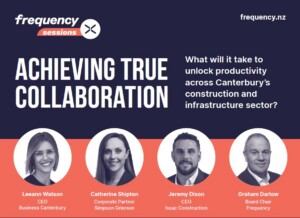
We were in Christchurch this month for our Frequency Sessions event, with ‘achieving true collaboration’ as the theme. The timing felt particularly relevant, as thousands of people descended on the city to mark the opening of Te Kaha Stadium – the final anchor project identified in the Christchurch Central Recovery Plan.
The discussion wasn’t about collaboration in an abstract sense. It was grounded in what it actually takes to deliver infrastructure well (or any big project really), across a system that is inherently complex, and often fragmented, particularly for a country the size of ours.
What struck me wasn’t that people see collaboration as important. That’s a given. It was how quickly the conversation moved to where it breaks down in practice and what it takes to hold alignment when different organisations, pressures, politics, and priorities come into play.
There was a level of honesty in the room that felt familiar. Because we’ve seen this before, and most of us in the room have lived it and breathed it before.
In Aotearoa, collaboration isn’t something we need to invent. It’s something we’ve already demonstrated, most clearly through post-earthquake recovery, where the usual rules and boundaries between clients, consultants, contractors, central and local government, and iwi were reset in response to a crisis.
Things moved differently in that environment, and while not every decision or action may have been perfect, there was a strong sense of shared purpose and vision, a greater level of trust and transparency surfaced, risks sharing was more equal. A shift from coordinating our work to working in true partnership was incredibly powerful and resulted in decision making that was more purposeful and timelier.
And importantly, it worked – the Christchurch City and Kāikoura of today attest to that.
Which raises a more uncomfortable question, if we know collaboration works, why is it so difficult to sustain it once that sense of urgency fades? Why has it not become Business as Usual?
From our perspective as project managers, a lot of it comes down to how the system is set up, including the way that we strategically make decisions and prioritise investment, the way we procure projects, how we allocate risk, how we determine where accountability sits, and how we ultimately measure success.
None of these are wrong in isolation. But together, they can create conditions where alignment, trust and transparency become harder to maintain over time, and where true collaboration starts to feel out of reach, rather than something fundamental to supporting equitable risk and reward and successful project delivery.
These tensions came through clearly in Christchurch from all our panellists.
There was a shared recognition that collaboration isn’t just about intent or behaviour – it needs to be enabled structurally and reinforced through the way projects are planned and delivered.
For us at Frequency, this is the space we operate in every day.
Project management sits in the middle of that system, between sectors and organisations, clients and contractors, between stakeholders, between stages of delivery, and often between competing priorities. Our role is to help create clarity, connect perspectives, and support decisions that move projects forward.
And in that context, collaboration isn’t a layer we add. It’s how the work gets done.
The conversation in Christchurch felt like a reminder of what’s possible when that alignment is present, and what’s at risk when it isn’t.
In a world full of distrust and competition, the risk is that collaboration is further deprioritised and devalued. But for us, down in little ‘ole New Zealand, the opportunity now is not to prove that collaboration works, it’s to make it sustainable.
– Emma Hodgkin – a proud Cantabrian, now living in Ōtepoti Dunedin with her family.